
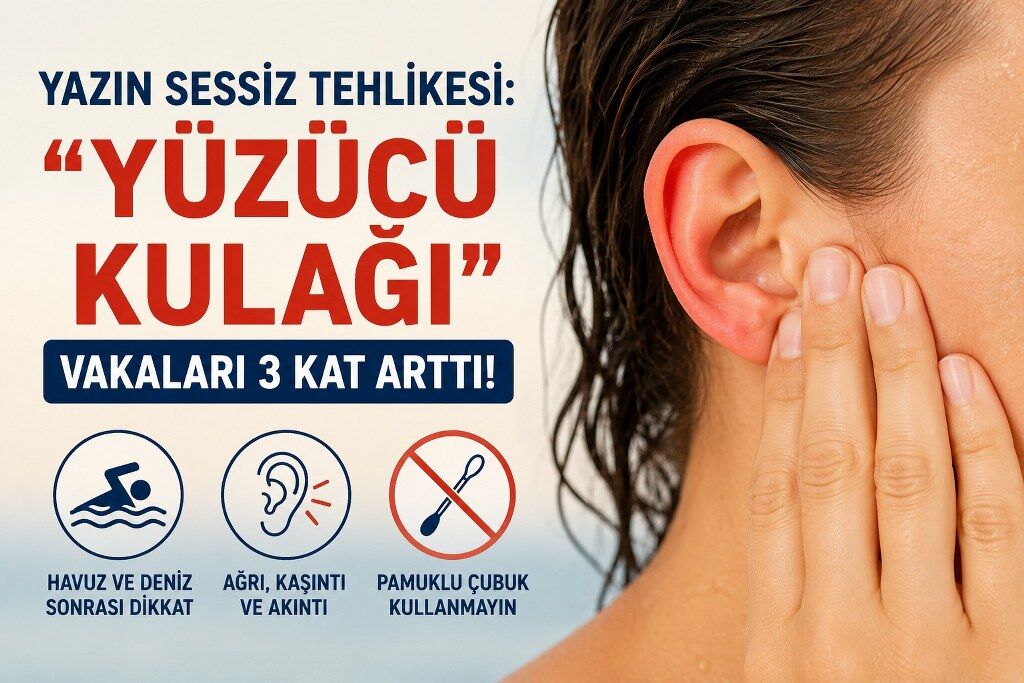
Silent danger of summer: "Swimmer's ear" cases increased 3 times
Ear Nose Throat Specialist Dr. Saim Pamuk stated that with the increase in pool and sea use during the summer months, there has been a significant rise in external ear canal infection cases, warning to keep the ear dry and not to use cotton swabs.
As pool and sea usage increases with rising temperatures, Ear Nose Throat Specialist Dr. Saim Pamuk warns against external ear canal infections, saying, "We see the number of applications increase 2-3 times. Patients may present with temporary hearing loss due to complete blockage of the external ear canal and discharge from the ear. We can advise gently drying the ears with a towel after swimming; keeping the external ear canal dry is important," he said.
While increased temperatures and frequent swimming in pools and seas during the summer months can cause problems, experts draw attention to external ear canal infections, commonly known as "swimmer's ear". Uzm. Dr. Saim Pamuk from Bakırköy Dr. Sadi Konuk Training and Research Hospital's Ear Nose Throat Department also gave warnings against this infection which can manifest with symptoms like ear pain, itching, and discharge. Dr. Pamuk noted that the prolonged moisture in the ear during summer facilitates bacterial growth. He emphasized that using cotton swabs for ear cleaning can damage the ear canal's natural protective layer and advised avoiding putting objects into the ear.
"We see applications increase 2-3 times"
Providing information about the infection, Uzm. Dr. Saim Pamuk said, "Infections seen after swimming in pools and seas during summer especially affect the external ear canal. External ear canal infection, known popularly as swimmer's ear, occurs particularly after swimming in the sea or pool and the condition of the external ear canal in moist and hot weather. These patients present with complaints of pain, discharge, and itching in the external ear canal. We recommend patients keep the external ear canal dry, avoid letting water enter if they swim in the sea or pool, and protect themselves with earplugs or a swimming cap if necessary. We observe the number of applications to our clinic increasing 2-3 times. We can classify ear infections into three types: affecting the external ear canal, middle ear, and inner ear," he said.
"The layer we call earwax functions as a protective barrier"
Continuing his remarks, Pamuk said, "The otitis externa condition called swimmer's ear shows a 50% increase in July and August compared to the winter months. Normally, our external ear canal has an acidic pH. The layer we call earwax serves as a protective barrier in the external ear canal. This barrier is damaged after swimming in pools and seas during summer, changing the acidic environment to a basic one. This leads to an increase in microorganisms, and the high temperature and humid air also increase colonization here. It can often be seen in children, adolescents, swimmers, patients with additional diseases like diabetes, and those with various malignancies," he stated.
"Absolutely stop putting anything in your ear with cotton swabs"
Noting that itching, watering, and blockage can occur in the early period, Pamuk said, "Patients may come to us complaining of temporary total hearing loss due to complete blockage of the external ear canal and discharge from the ear. Studies on divers have found a 20-30% increase in external ear canal infections compared to normal swimmers. We must absolutely stop the habit of disturbing our ears with cotton swabs. This provides a basis for microorganisms to spread deeper and increases infection frequency. We advise people to gently dry their ears with a towel or use a hairdryer at a low setting to dry moisture and liquid from a distance after swimming during summer. We recommend an ear examination once a year. We advise against using electronic earphones with wet ears," he said.
"Keeping the external ear canal dry is important"
Speaking about applications, Pamuk said, "The frequency of patients applying to our clinic with external ear canal infection has increased during this period. External ear canal infection diseases show an increase between 40% and 60% during the summer period. Compared to the winter months, there is a 2-3 fold increase in July and August. In the treatment of these patients, keeping the external ear canal dry is important. We highly value keeping the external ear canal dry with aspiration and dressing. As home treatment, we provide drops, antibiotic and steroid drops. We prescribe preparation drops that regulate the acid level of the external ear canal. Fungal infections are also seen. During summer, since people are more connected with picnics and nature, we do not only see external ear canal infections. In one of my patients who came with external ear canal itching, I detected a spider during endoscopic examination. We removed it; the patient felt better. It is useful not to associate problems only with pools and swimming," he said.