Sperm whale migration season has begun | Marine Mammals Research Association: “The Mediterranean is not just on the must-see list for us in summer”
The Marine Mammals Research Association (DMAD) announced that the migration season of sperm whales in the Mediterranean has started, noting that sperm whales were recorded off the coasts of Hatay and Muğla in the summer of 2026, and provided an informative statement about sperm whales.
The Marine Mammals Research Association (DMAD) made an information statement regarding whales seen off the coast of Göcek Neighborhood in the Fethiye district of Muğla and off the coast of Samandağ district in Hatay.
In a statement made on June 2 on DMAD's social media account, it was reminded that the Mediterranean hosts sperm whales every summer. The statement noted that the migration season of sperm whales has started, using the expression: "The Mediterranean is not just on the must-see list for us in summer; sperm whales also visit the coastline of our country every summer."
According to the statement about sperm whales, also known as cachalots, the first seasonal recording came from Samandağ district in Hatay. The second recording was taken from the waters off Muğla, approximately 500 kilometers away. It was stated that the whales in the shared footage are two adult male individuals.
DMAD also shared information about sperm whales. According to the information, sperm whales can dive up to one thousand meters deep in a single breath, stay underwater for up to 45 minutes, and conduct their hunting in these deep waters.
The statement also touched on the species' social structure. Adult males mostly live alone, young males live in groups; females and calves form groups of five to ten individuals called "social units." Male individuals migrate by traveling long distances to find females.
“THE DIALECTS DO NOT MIX”
Among the information shared by the association was the communication method of sperm whales. Producing sound sequences called "codas," sperm whales' sounds differ between groups, similar to how Black Sea and Aegean dialects differ in Turkish. It was conveyed that whales have their own unique "dialects," but these dialects do not mix.
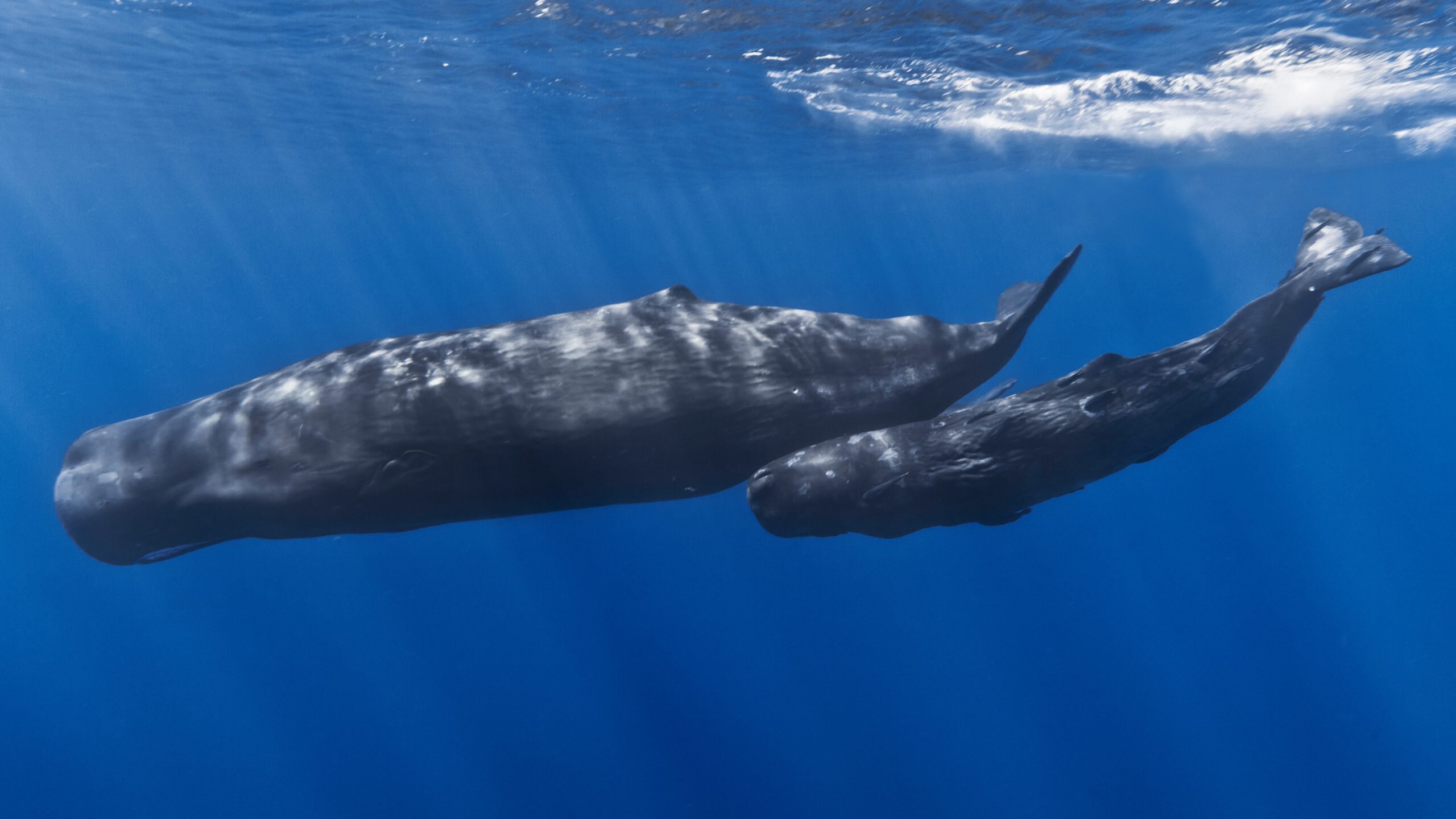
DMAD stated that while the mother feeds in deep waters, the calf stays on the surface and follows the mother through sounds, which can be heard from distances over 20 kilometers.
“MARINE TRAFFIC AND NOISE CAN OBSTRUCT COMMUNICATION BETWEEN MOTHER AND CALF”
The association warned that marine traffic and noise-generating activities can disrupt this communication, breaking the bond between mother and calf.
The statement also emphasized that sperm whales play a role as "silent warriors" in combating the climate crisis by storing tons of carbon in their bodies.
DMAD WILL TRACK SPERM WHALES FOR A MONTH
Finally, the statement announced that the DMAD team will monitor the sperm whales for one month starting from June 28.
The association also drew attention to the ecological significance of the Samandağ coasts, Milleyha Wetlands, and Asi River. It was stated that the Asi River, which increases the productivity of the Eastern Mediterranean with the nutrients it carries, supports both coastal organisms and life in the open sea.
DMAD noted that the birds in Milleyha, the sea turtles on the Samandağ beaches, and the sperm whales in the depths of the Mediterranean are parts of the same ecological network, and that a process starting from a river can extend over hundreds of kilometers to the life of a whale.
ABOUT SPERM WHALES (CACHALOTS)
According to information provided by NOAA Fisheries, affiliated with the US National Oceanic and Atmospheric Administration, the sperm whale (Physeter macrocephalus) is among toothed whales and is distributed across all deep oceans from the equator to the ice boundaries in the Arctic and Antarctic.
According to NOAA Fisheries, sperm whales dive deep to search for food; their dives often reach 600 meters and last up to 45 minutes, after which they surface, breathe and rest for several minutes, then dive again. Scientific research shows dives reaching up to 3,000 meters and durations up to two hours have also been recorded.
According to data from the International Whaling Commission (IWC), sperm whales in the Mediterranean hold a distinct status. This population is genetically separate from Atlantic populations and is classified as "endangered" according to the International Union for Conservation of Nature (IUCN) criteria.
The estimated number of individuals is below 2,500. Ship strikes and entanglement in fishing gear are among the primary threats. According to the IWC, globally, the species is listed as "vulnerable" on the IUCN Red List of Threatened Species.